

The order fulfillment process steps are the sequence of operations that move a product from your warehouse shelf to your customer’s doorstep. Additionally, getting each step right directly determines whether shoppers come back or leave a one-star review.
Table of Contents
- Why Fulfillment Performance Matters More Than Ever
- The Core Order Fulfillment Process Steps
- Technology That Holds Every Step Together
- Multi-Channel Fulfillment Considerations
- Things to Know
- Build a Faster Fulfillment Operation With Warehouse Logistics NYC
- Frequently Asked Questions
Why Fulfillment Performance Matters More Than Ever
The pressure on brands to ship fast has never been higher. According to the Cart.com 2025 Fulfillment Industry Report, 56% of consumers now expect same-day or two-day delivery as a standard shipping option. Meanwhile, U.S. delivery expectations have dropped from 5.7 days five years ago to just 2.5 days in 2024, with projections reaching 1.5 days by 2029.
That trajectory leaves almost no room for operational slack. The global e-commerce fulfillment services market reflects this urgency. Grand View Research valued the market at USD $123.68 billion in 2024, projecting it to reach USD $272.14 billion by 2030, growing at a 14.2% CAGR.
Therefore, understanding supply chain management basics is the foundation upon which every fulfillment improvement is built. Each misstep compounds downstream, so mastering the order fulfillment process steps becomes critical for success.
The Core Order Fulfillment Process Steps
Step 1: Receiving Inventory and Order Fulfillment Process Steps
Everything starts when inbound goods arrive at the warehouse. At this stage, staff verify SKUs against purchase orders and inspect for damage. They log each unit into the warehouse management system (WMS). Errors here cascade through every downstream step, so accuracy during receiving is non-negotiable.
Step 2: Inventory Storage and Slotting for Order Fulfillment Process Steps
Once received, products are assigned storage locations based on velocity and size. High-turnover SKUs typically slot closest to packing stations to minimize travel time. Moreover, poor slotting decisions quietly erode pick efficiency.
Therefore, periodic re-slotting as your product mix shifts is a standard best practice in the order fulfillment process steps.
Step 3: Order Management and Processing
When a customer places an order, it flows from your sales channel into the order management system. This triggers a pick list and routes it to the warehouse floor. Automated routing reduces manual intervention and cuts the window between order placement and pick-start significantly.
According to Grand View Research, companies using real-time inventory management experience 35% faster order processing times compared to those relying on manual methods.
Step 4: Pick and Pack Operations
Picking is the most labor-intensive stage of the order fulfillment process steps. Workers (or in advanced operations, autonomous mobile robots) retrieve items from storage locations based on the pick list. Once all items are gathered, the pack station applies appropriate dunnage and selects the right box size to minimize dimensional weight charges.
Additionally, workers print the shipping label at this stage. At ShipNetwork’s 2025 Peak Season Report benchmarks, top-performing operations are hitting 99.975% order accuracy. This equates to just 2.5 errors per 10,000 orders.
Step 5: Shipping and Carrier Selection
The packed order moves to a shipping station where carrier rates are compared in real time. Carrier selection should account for delivery speed, zone, and weight. Furthermore, knowing how to reduce shipping costs at this stage can meaningfully protect your margins at scale.
You can achieve this through zone skipping, carrier diversification, or rate shopping software. For larger wholesale or B2B shipments moving on pallets, understanding what is ltl freight becomes relevant, since less-than-truckload shipping is often the most cost-effective option for mid-volume B2B orders.
Step 6: Delivery and Last-Mile Logistics
Last-mile delivery is the final leg from a regional carrier facility to the customer’s address. It is also the most expensive segment of the shipping journey, often representing more than 50% of total delivery costs.
In contrast, strategic use of regional carriers and zone-based fulfillment networks can cut transit times while keeping costs manageable in your order fulfillment process steps.
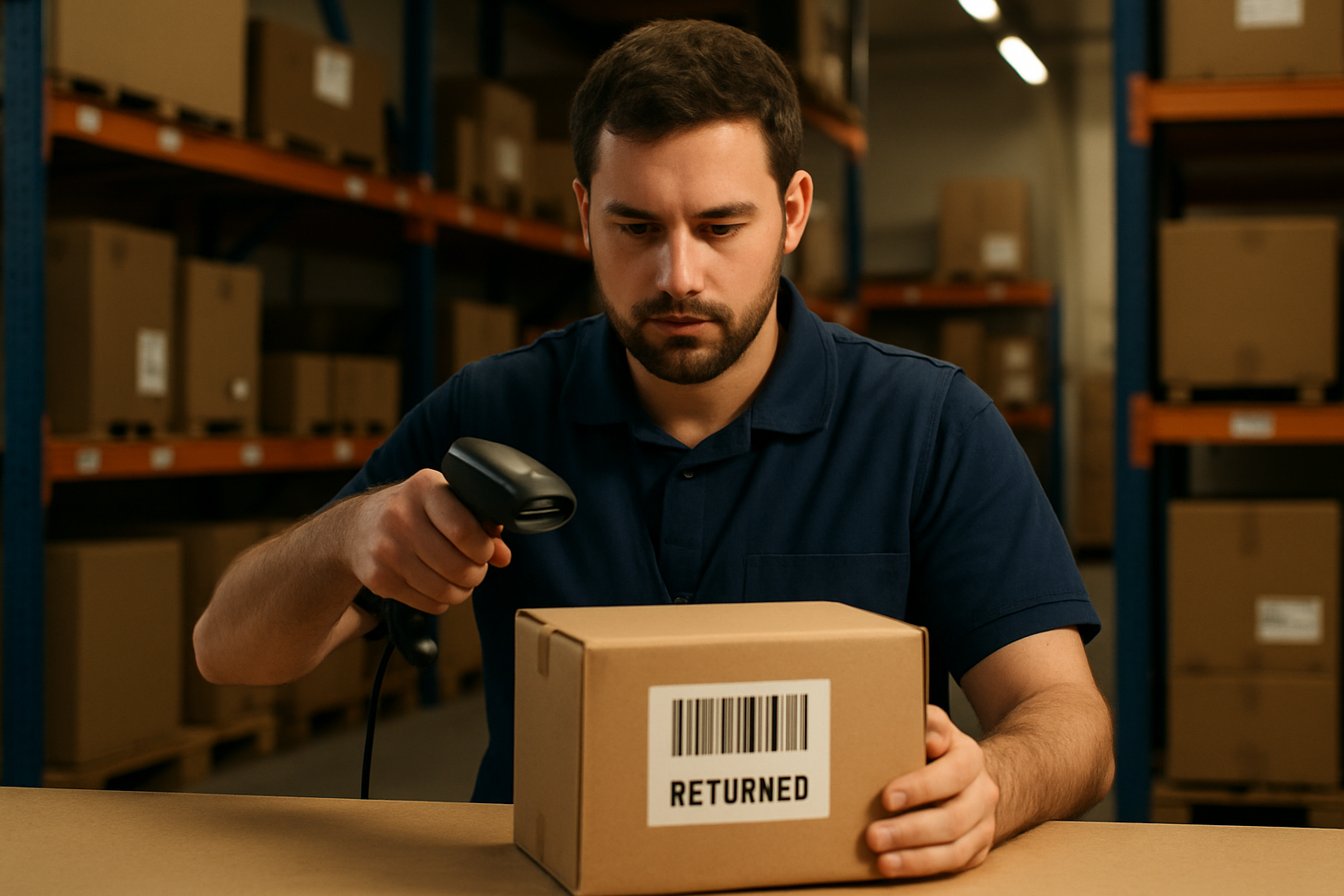
Step 7: Returns Management and Order Fulfillment Process Steps
Returns are an unavoidable part of eCommerce. The National Retail Federation projects 19.3% of online sales will be returned in 2025, with total retail returns estimated at $849.9 billion. A streamlined returns process restores inventory quickly and reduces refund delays.
Additionally, it protects customer relationships. Operations that treat reverse logistics as an afterthought typically see higher restocking delays and elevated shrinkage.

Technology That Holds Every Step Together
No single step operates in isolation. A warehouse management system connects receiving, storage, picking, packing, and shipping into one data environment. The global Order Fulfillment Software market was valued at USD $1,732.87 million in 2024.
Moreover, this market is expected to reach USD $3,841.09 million by 2027, expanding at a 14.19% CAGR. This reflects how seriously operators are investing in this infrastructure for their order fulfillment process steps.
Key technology layers include:
- WMS (Warehouse Management System): Controls inventory location, pick routing, and cycle counting.
- OMS (Order Management System): Aggregates orders from multiple sales channels and routes them to the correct fulfillment node.
- Rate Shopping Software: Compares carrier rates at the point of label creation to minimize shipping spend.
- EDI Integration: Required for B2B and wholesale brands working with major retailers; ensures compliance with retailer routing guides.
Multi-Channel Fulfillment Considerations
Brands today rarely sell through a single storefront. According to the ShipBob 2026 State of Ecommerce Fulfillment Report, 85.82% of brands now sell on two or more sales channels, up from 78% the prior year. Additionally, 55.29% sell on three or more channels.
Each additional channel introduces its own order format, SLA requirements, and return policy. Therefore, this places greater strain on the fulfillment operation. Many brands address this complexity by working with a third-party logistics provider.
According to the ShipBob 2026 report, 84.13% of brands are already using a third-party fulfillment company for at least some of their orders. Understanding what is a 3pl company helps brands evaluate whether outsourcing fulfillment makes more operational and financial sense than managing it in-house.
This becomes particularly relevant as order volume and channel count grow in the order fulfillment process steps.
Things to Know
- Receiving errors multiply downstream. A mislabeled SKU at inbound creates mispicks and incorrect shipments. These costly returns appear weeks later.
- Dimensional weight pricing affects every carrier. Oversized packaging inflates your shipping invoice even when the actual product is light. Box right-sizing at the pack station matters significantly.
- Same-day fulfillment rates vary by cutoff time. Carriers impose order cutoff windows. Your internal pick-and-pack cycle must finish before those windows, or same-day becomes next-day.
- Kitting adds complexity but increases AOV. Bundling products into kits at the fulfillment stage is a common tactic for brands boosting average order values. However, it requires pre-assembly planning and dedicated WMS logic.
- Returns are a retention opportunity. A fast, easy return experience is one of the highest-ROI investments a brand can make in customer loyalty during the order fulfillment process steps.
Build a Faster Fulfillment Operation With Warehouse Logistics NYC
Your customers are not willing to wait, and your competitors are not standing still. Warehouse Logistics NYC offers same-day shipping and real-time inventory visibility through our WMS. Additionally, we provide EDI-compliant B2B fulfillment and full returns management from our strategically located NYC fulfillment hub.
Request your free estimate today and find out exactly how we can take fulfillment off your plate. You can then focus on growing your brand. Tell us your current order volume and channel mix, and we will build a custom fulfillment plan for you.
Frequently Asked Questions
Q: How many steps are in the order fulfillment process?
Most fulfillment operations involve seven core steps: receiving, storage, order processing, picking, packing, shipping, and returns management. Each step feeds directly into the next, so inefficiencies at any point affect the overall cycle time.
Therefore, brands with strong WMS infrastructure can automate transitions between steps. This significantly reduces manual handoffs in the order fulfillment process steps.
Q: What is the most common cause of fulfillment errors?
Inaccurate inventory data is the most common root cause of fulfillment errors, including mispicks, stockouts, and incorrect shipments. When inventory counts in the system do not reflect physical stock, pick lists route workers to locations with missing or wrong items.
Regular cycle counting and real-time WMS updates are the standard corrective measures for addressing errors in your order fulfillment process steps.
Q: When should a brand outsource its fulfillment to a 3PL?
Brands typically benefit from outsourcing when in-house fulfillment costs exceed 3PL rates. Additionally, outsourcing makes sense when order volume exceeds what the internal team can handle without sacrificing accuracy or speed.
Other strong signals include expanding into new sales channels, entering B2B wholesale, or needing geographic distribution to reduce transit times. A 3PL also removes the capital burden of leasing and staffing a warehouse.
Q: How does multi-channel selling complicate fulfillment?
Each sales channel has its own order format, SLA requirements, and sometimes unique labeling or packaging standards. This adds operational complexity to the order fulfillment process steps.
A brand selling on its own website, Amazon, and wholesale simultaneously must ensure its WMS and OMS can handle all three without creating inventory conflicts or missed deadlines. Moreover, EDI compliance is often mandatory for retail wholesale accounts.
Q: What is a realistic order accuracy benchmark for eCommerce fulfillment?
Top-performing fulfillment operations target 99.9% or higher order accuracy, with peak-season benchmarks from ShipNetwork’s 2025 report citing 99.975% accuracy. For a brand shipping 10,000 orders per month, that benchmark means fewer than three errors per month.
Achieving this level requires barcode scanning at every pick and pack stage in the order fulfillment process steps. Visual confirmation alone is insufficient for maintaining these standards.