

Freight shipping in New York represents one of the most complex and high-volume logistics operations in the country. The region’s dense population, massive port infrastructure, and commercial demand make it essential to understand how freight shipping New York works. Whether you are moving pallets across the tri-state area or coordinating inbound ocean containers through the Port of New York and New Jersey, mastering these logistics is critical to keeping your supply chain competitive.
Table of Contents
- The Scale of New York’s Freight Shipping Market
- How Freight Shipping Works in NYC
- LTL vs. FTL: Choosing the Right Freight Shipping Option
- Key Cost Factors in New York Freight
- How 3PL Providers Fit Into Freight Shipping New York
- Things to Know
The Scale of New York’s Freight Shipping Market
New York’s freight and logistics market is not just large—it is structurally important to the entire U.S. economy. According to Mordor Intelligence (2025), the market reached $71.19 billion in 2025. This represents an increase from $69.29 billion in 2024. The market is projected to reach $80.99 billion by 2030 at a compound annual growth rate of 2.67%.
At the national level, freight forwarding brokerages and agencies reached $127.7 billion in 2025, according to IBISWorld (2025). This reflects a 2.1% increase over the prior year. Additionally, Straits Research (January 2025) projects the global freight transport market to grow from $40.46 billion in 2025 to $95.96 billion by 2033 at a 11.4% compound annual growth rate.
Public investment is accelerating this growth significantly. In March 2024, New York Governor Kathy Hochul announced a record $111.1 million investment in port and freight rail infrastructure. The funding was allocated across 38 distinct projects. Furthermore, NYC secured a USDOT RAISE grant of $5.6 million in 2024 to establish the Urban Freight Mobility Collaborative, an initiative aimed at reducing greenhouse gas emissions and improving urban freight logistics.
How Freight Shipping Works in NYC
Freight moves into, out of, and through New York across several interconnected modes. These include trucking, rail, ocean, and air transport. The Port of New York and New Jersey operates as the busiest port on the East Coast and ranks among the largest in the country. Most commercial freight entering the region passes through this gateway before distribution by truck to warehouses, retail locations, or directly to consumers.
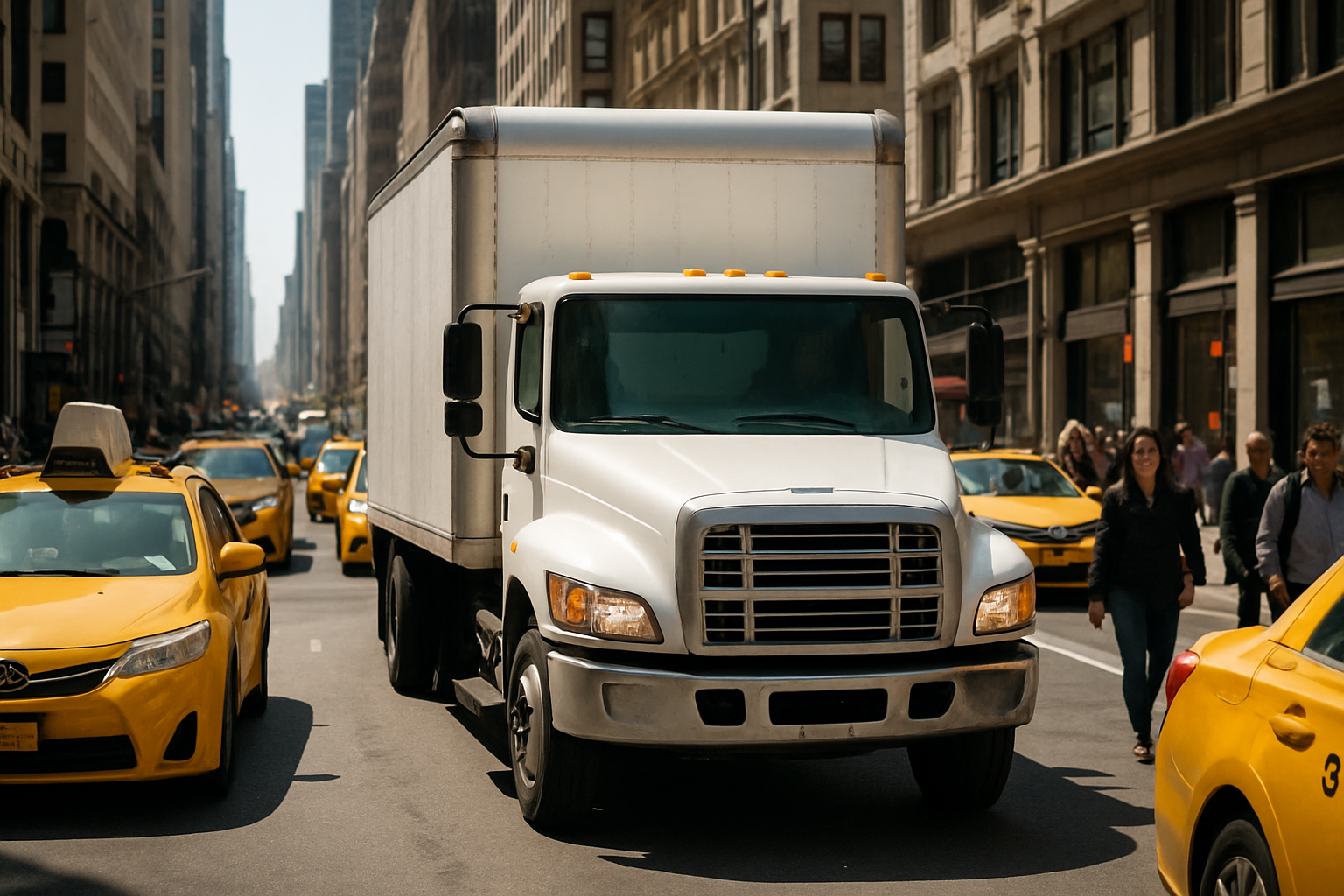
Urban freight in New York City faces distinct constraints that inland markets do not encounter. Congestion pricing, restricted delivery windows, and weight limits on certain bridges and tunnels all add layers of complexity. Limited dock space at urban facilities further complicates operations. Carriers account for these challenges in their pricing, which is why freight costs in NYC tend to exceed the national average.
Understanding supply chain management basics proves especially valuable in this context. The interconnected nature of freight, warehousing, and last-mile delivery means a delay in one node ripples through the entire operation. However, businesses that treat freight as an isolated cost center rather than an integrated supply chain component typically pay more and experience greater disruption.
LTL vs. FTL: Choosing the Right Freight Shipping Option
One of the first practical decisions any shipper faces is whether to move freight on a less-than-truckload or full truckload basis. If you are new to this distinction, our resource on what is ltl freight breaks down the mechanics clearly. LTL suits shipments that do not fill an entire trailer. In contrast, FTL proves more cost-effective when your load meets or exceeds roughly 10 to 15 pallets.
| Factor | LTL | FTL |
|---|---|---|
| Shipment size | 1-10 pallets | 10+ pallets or full trailer |
| Cost structure | Pay per pallet/cwt | Flat rate for truck |
| Transit time | Longer (multiple stops) | Faster (direct) |
| Freight handling | Multiple touches | Single load/unload |
| Best for | Smaller, frequent shipments | Large, time-sensitive loads |
| Risk of damage | Slightly higher | Lower |
In New York, LTL is extremely common among mid-size eCommerce brands and wholesale distributors. These businesses replenish retail shelves or fulfill B2B orders on a rolling basis. FTL makes more sense for manufacturers or importers moving full container equivalents from the port to a distribution center.
Key Cost Factors in New York Freight
Freight rates are not arbitrary—several specific variables drive what you pay in the New York market:
- Freight class: Carriers determine this by evaluating density, stowability, handling requirements, and liability. Higher classes result in higher per-hundredweight costs.
- Accessorial charges: Liftgate service, inside delivery, residential delivery, and limited access surcharges are common in urban environments like NYC. These fees add up quickly.
- Fuel surcharges: These fluctuate weekly based on national diesel price indices published by the U.S. Department of Energy. Monitoring these indices helps predict rate movements.
- Carrier capacity: The American Trucking Associations reported 3.58 million truck drivers employed in 2024, a 0.8% decrease from 2023. Driver turnover at small carriers exceeded 90% in 2024. Tighter driver supply puts upward pressure on rates during peak periods.
- Delivery zone: Last-mile deliveries into Manhattan or the outer boroughs carry premiums versus delivery to suburban New Jersey or Long Island. These zone premiums can significantly impact total costs.
Knowing where these costs originate is the first step toward controlling them. Our guide on how to reduce shipping costs outlines practical tactics. Shippers in high-cost urban markets can apply these strategies without sacrificing service levels.

How 3PL Providers Fit Into Freight Shipping New York
Many growing brands operating in or shipping to New York find that managing freight in-house becomes operationally unsustainable as order volume scales. This is where third-party logistics providers become strategically valuable. Furthermore, understanding what is a 3pl company will clarify what these providers actually do and where they create measurable value.
Warehouse Logistics NYC operates as a 3PL provider positioned in NYC’s logistics hub. The company offers freight coordination and last-mile delivery alongside warehousing and B2C eCommerce fulfillment. Additionally, they provide B2B and wholesale fulfillment with EDI compliance, pick and pack services, kitting, labeling, returns management, and real-time inventory visibility through a warehouse management system. For eCommerce, retail, and wholesale brands that need to move product in and out of the New York metro efficiently, consolidating these functions under one provider reduces coordination overhead. This approach often improves carrier negotiating leverage.
In November 2024, Intercontinental Exchange invested in the New York Shipping Exchange (NYSHEX). The platform is set to debut its own container freight indices in 2025. This signals continued institutional interest in bringing greater price transparency and contract reliability to the New York freight market, which benefits shippers negotiating long-term rates.
Things to Know
- Freight shipping in New York is subject to congestion-related surcharges that vary by borough and even by specific delivery address. Always verify accessorial fees before accepting a quote.
- The Port of New York and New Jersey operates under specific terminal appointment systems. Missing a pickup window often results in detention fees that add up quickly.
- Dimensional weight pricing applies on most LTL and parcel shipments. A light but bulky item may be priced at a higher billable weight than its actual weight.
- EDI compliance is increasingly required for wholesale and retail vendor shipments in New York. Non-compliance can trigger chargebacks from major retail partners.
- Partnering with a 3PL that already has established carrier relationships in the New York market can reduce rate volatility compared to booking spot freight independently.
Let Us Handle the Complexity of New York Freight
Coordinating freight in one of the country’s most demanding logistics markets requires more than a carrier list. We help eCommerce, retail, and wholesale businesses in and around New York move product faster. You benefit from lower per-unit costs and real-time visibility from the moment inventory arrives at our facility.
Request a free freight estimate and find out how Warehouse Logistics NYC can streamline your inbound and outbound freight operations starting today. Tell us your shipment volume, current pain points, and target delivery zones. We will put together a custom plan built for the New York market.
Frequently Asked Questions
Q: What is the average cost of freight shipping in New York?
A: Freight shipping costs in New York vary significantly based on shipment size, freight class, delivery zone, and accessorial charges. LTL rates in the NYC metro typically run higher than the national average due to urban delivery complexity and carrier surcharges. Therefore, the best way to get an accurate number is to request quotes from multiple carriers or work with a 3PL that has pre-negotiated rates.
Q: How long does freight shipping take within New York State?
A: Transit times for intrastate freight within New York State typically range from one to three business days depending on origin, destination, and mode. Shipments moving within the five boroughs face different constraints than those traveling between the city and upstate markets. LTL shipments generally take longer than FTL due to multi-stop routing.
Q: Do I need a freight broker or a 3PL for New York shipping?
A: A freight broker connects you with carriers but does not handle warehousing. In contrast, a 3PL can manage warehousing, fulfillment, and freight under one roof. For businesses with consistent volume and complex fulfillment needs, a 3PL typically offers more integrated value. Brokers are better suited for one-off or spot shipments where you are primarily seeking carrier access.
Q: What freight class should I use for my shipment?
A: Freight class is determined by the National Motor Freight Classification system using four factors: density, stowability, handling requirements, and liability. Misclassifying freight is one of the most common and costly mistakes shippers make. Carriers can re-class a shipment upon delivery and issue a corrected invoice. Therefore, when in doubt, use a freight class calculator or consult a logistics provider before booking.
Q: Is LTL or FTL better for shipping into Manhattan?
A: For most small to mid-size loads moving into Manhattan, LTL is the more practical and cost-effective option, provided delivery timing is flexible. FTL into Manhattan is feasible but requires careful planning around truck size restrictions, delivery window permits, and dock availability. Many shippers use a 3PL facility in New Jersey or the outer boroughs as a staging point, then use smaller vehicles for urban last-mile delivery.