

Inventory management services are professional solutions that help businesses track, organize, and control stock across storage and fulfillment operations. When implemented correctly, they reduce costly errors, prevent stockouts, and give operators real-time visibility into what they have, where it is, and when to reorder. These inventory management services transform how companies handle their most critical operational asset.
Table of Contents
- What Inventory Management Services Actually Cover
- The Technology Driving Modern Inventory Control
- Operational Challenges That Make Inventory Management Services Necessary
- How a 3PL Fits Into Your Inventory Strategy
- Comparing In-House vs. Outsourced Inventory Management Services
- Things to Know
- Frequently Asked Questions
What Inventory Management Services Actually Cover
At their core, inventory management services span far more than simply counting boxes on a shelf. A full-service provider handles receiving, putaway, cycle counting, order tracking, replenishment alerts, returns processing, and reporting. All of these tie together through a warehouse management system (WMS).
For eCommerce and retail brands, this means being able to see SKU-level stock positions in real time. You can reconcile discrepancies before they affect orders. Additionally, you can coordinate fulfillment across multiple sales channels simultaneously. B2B operations add another layer, requiring EDI compliance, pallet-level accuracy, and vendor-managed inventory protocols that align with retailer routing guides.
Understanding supply chain management basics is helpful here because inventory sits at the intersection of procurement, warehousing, and distribution. Any gap in accuracy at the inventory layer creates ripple effects throughout the entire supply chain.
The Technology Driving Modern Inventory Control
The software market underpinning these services has grown significantly. According to Grand View Research (2026), the global inventory management software market was valued at $3.7 billion in 2025. The market is projected to reach $7.1 billion by 2033, growing at a CAGR of 8.9%. A separate projection from Future Market Insights (2026) places the 2025 market at $2.4 billion. Therefore, growth is expected to reach $9.4 billion by 2036, reflecting different methodological scopes but confirming the same directional trend.
Adoption is accelerating rapidly. More than 68% of medium and large U.S. companies had deployed digital inventory platforms as of 2024. Moreover, over 65% of enterprises moved to cloud-based solutions specifically to improve visibility and accuracy, according to 360 Research Reports (2025). AI is a major reason why.
More than 45,000 organizations globally now use AI-enabled tracking systems. These systems achieve 98.7% accuracy in stock-level forecasting. Furthermore, the same source found that AI-driven analytics improved inventory turnover rates by 18% and reduced warehouse discrepancies by 24% (360 Research Reports, 2025).
For SMBs, the shift is equally pronounced. SME inquiries for SaaS inventory solutions grew 34% year-on-year in 2024. This growth was driven largely by cross-border eCommerce demand, according to Mordor Intelligence (2025). In addition, omnichannel merchants that deployed end-to-end RFID capture raised accuracy by 15 percentage points during 2025, per PackageX reporting.
If your operation involves freight coordination, it also pays to understand what is ltl freight and how less-than-truckload shipping intersects with reorder timing and storage optimization.
Operational Challenges That Make Inventory Management Services Necessary
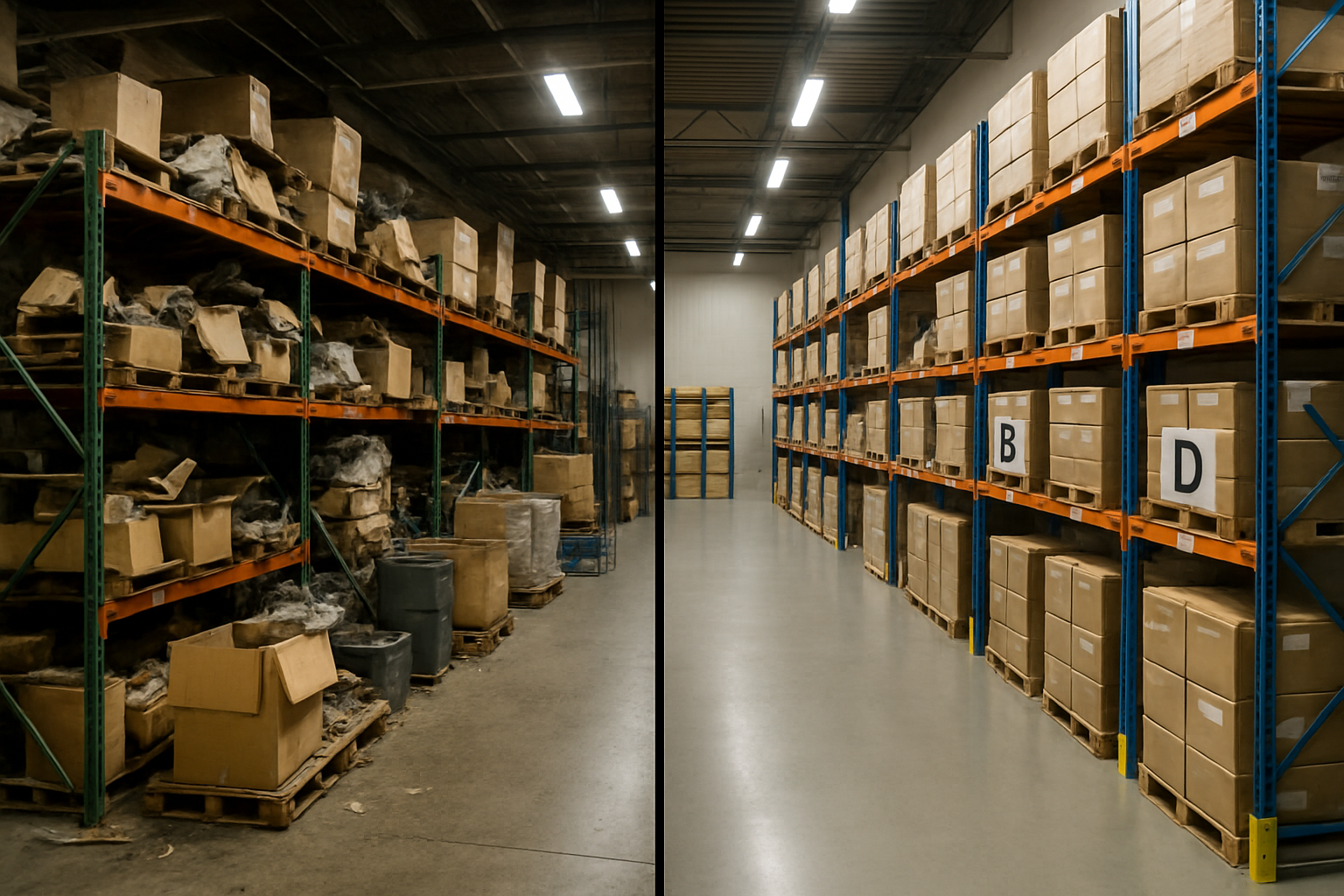
Despite the technology available, many businesses still struggle with foundational accuracy problems. Recent data from June 2026 shows that 58% of businesses operate below 80% inventory accuracy. Lead time variability affects 72% of SMBs. Additionally, minimum order quantity constraints challenge 54% of businesses. These are not edge cases; they represent the baseline reality for a large share of U.S. operators.
The consequences are predictable: overselling, excess safety stock, rushed freight spend, and customer service failures. Businesses that rely on spreadsheets or disconnected point-of-sale systems often discover discrepancies only after an order has already been placed. At that point, recovery becomes expensive.
Businesses looking to reduce unnecessary freight spend can pair accurate inventory data with strategies on how to reduce shipping costs, since better stock visibility directly reduces emergency reshipment and expedited freight scenarios.

How a 3PL Fits Into Your Inventory Strategy
Outsourcing to a third-party logistics provider is one of the most direct ways to access professional inventory management services without building internal infrastructure. A 3PL integrates warehousing, fulfillment, and inventory tracking under one operational umbrella. This simplifies vendor management and reduces the number of systems a brand needs to maintain independently.
Warehouse Logistics NYC, a 3PL provider serving eCommerce, retail, wholesale, and manufacturing brands from its New York City logistics hub, offers real-time inventory visibility through its WMS platform. Its services include pick and pack, kitting and assembly, returns management, B2B fulfillment with EDI compliance, and same-day shipping. All of these are built around a single inventory layer that clients can access without maintaining their own warehouse staff or software stack.
If you are evaluating this option for the first time, reviewing what is a 3pl company will clarify how these providers structure their service agreements and where inventory management sits within a broader logistics arrangement.
Comparing In-House vs. Outsourced Inventory Management Services
The decision between managing inventory internally and outsourcing to a service provider depends on volume, SKU complexity, growth trajectory, and available capital. Below is a practical breakdown of the key differences.
| Factor | In-House Management | Outsourced (3PL) Services |
|---|---|---|
| Upfront cost | High (software, staff, space) | Lower (pay-per-use or contract) |
| Scalability | Limited by fixed capacity | Scales with volume |
| Technology access | Requires internal IT investment | Included in service offering |
| Accuracy control | Fully internal | Managed by provider’s WMS |
| Flexibility | Lower for seasonal spikes | Higher with overflow storage options |
| EDI/compliance support | Requires specialist staff | Often built into the service |
In-house management gives operators maximum control. However, it requires sustained investment in people, space, and systems. Outsourcing shifts that burden to a provider while typically delivering faster access to better technology. For brands with high SKU counts, seasonal volume swings, or multichannel complexity, outsourced inventory management services frequently offer a better total cost of ownership.
Things to Know
- Cycle counting beats annual audits. Counting a rotating subset of SKUs continuously throughout the year catches discrepancies far earlier than a single annual physical count.
- Real-time visibility is not the same as accurate inventory. A system showing live data is only as reliable as the physical processes feeding it. Receiving errors and mis-picks corrupt even the best WMS.
- Safety stock calculations should be dynamic. Static safety stock levels set once and forgotten do not account for supplier lead time variability, which affects 72% of SMBs according to June 2026 data.
- EDI compliance failures are expensive. Retailers like Walmart and Target impose chargeback fees for non-compliant shipments. Therefore, accurate inventory labeling and packing verification become operationally critical.
- Returns data is inventory data. Brands that treat reverse logistics as separate from inventory management miss restocking opportunities and accumulate unseen shrinkage in returned goods.
Claim Your Free Inventory Assessment from Warehouse Logistics NYC
If stock discrepancies, fulfillment delays, or scaling challenges are costing your business time and revenue, professional inventory management services can address all three at the root level. Warehouse Logistics NYC works with eCommerce, retail, and wholesale brands. The company implements real-time inventory control through its WMS platform, same-day fulfillment capability, and full B2B compliance infrastructure. Request a free estimate today and get a clear picture of what outsourced inventory management would look like for your specific operation.
Frequently Asked Questions
Q: What is the difference between inventory management services and a WMS?
A warehouse management system (WMS) is the software tool. Inventory management services, however, encompass the full operational process around it. A WMS tracks stock movements, locations, and levels within a facility. In contrast, inventory management services include the people, workflows, and procedures that make that data accurate and actionable, such as receiving protocols, cycle counting, and discrepancy resolution.
Q: How much do professional inventory management services typically cost?
Costs vary widely based on SKU count, volume, and service scope. Outsourced solutions through a 3PL are often structured as per-unit or per-pallet fees rather than large fixed overhead. For many SMBs, this per-use pricing model is less expensive than maintaining dedicated warehouse staff and software licenses in-house. Requesting itemized quotes from multiple providers is the most reliable way to benchmark costs for your specific operation.
Q: Can inventory management services support multiple sales channels at once?
Yes, most modern inventory management services are built specifically to handle multichannel operations. These include eCommerce platforms, wholesale accounts, and retail replenishment simultaneously. Providers typically use a central inventory layer that deducts stock across all channels in real time. This prevents overselling and enables accurate available-to-promise commitments across Amazon, Shopify, EDI retailers, and other outlets.
Q: How do inventory management services handle product returns?
Returns are processed back into inventory through a defined reverse logistics workflow. This workflow inspects, grades, restocks, or disposes of items depending on their condition. Accurate returns processing prevents phantom inventory, which occurs when returned units are logged as received but never properly inspected or shelved. This is one of the most common sources of inventory discrepancy in high-volume fulfillment environments.
Q: What industries benefit most from outsourced inventory management services?
eCommerce, retail, wholesale, food and beverage, and manufacturing are among the industries that gain the most from structured inventory management services. These sectors share characteristics like high SKU counts, variable demand, and compliance requirements that make manual or spreadsheet-based tracking insufficient as volume grows.