
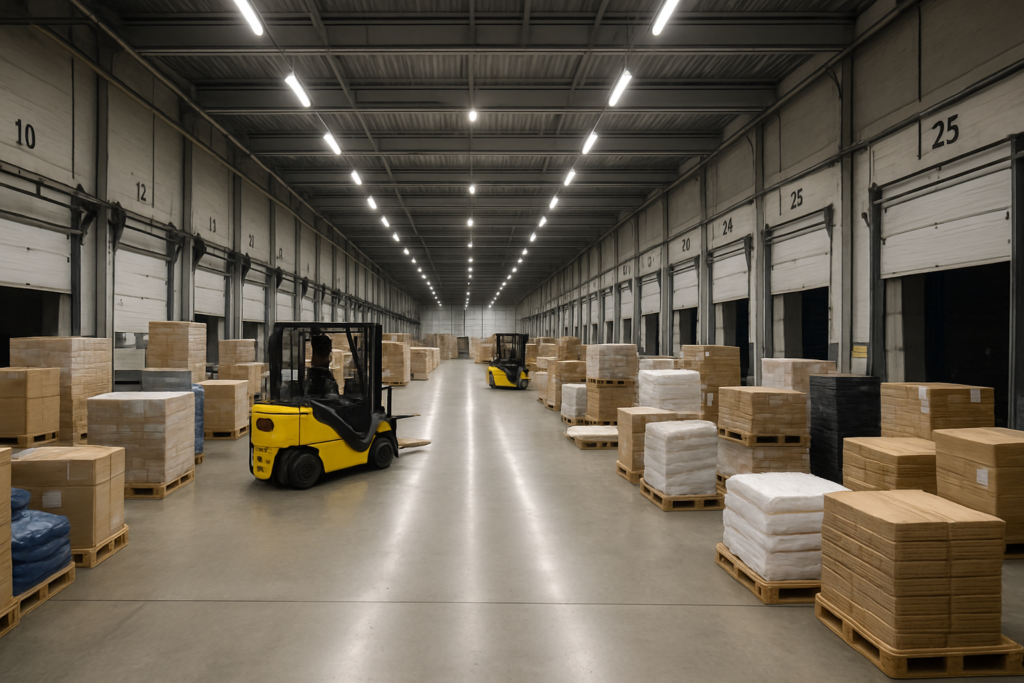
Cross docking is a logistics strategy where inbound freight transfers directly from receiving docks to outbound transport with little to no storage time in between. Rather than holding inventory in a warehouse, goods flow through a transit facility, often within hours, before moving to their final destination. Understanding what is cross docking has become essential for shippers managing tight delivery windows and rising freight costs.
Table of Contents
- The Core Mechanics of What Is Cross Docking
- Types of Cross Docking Operations
- Where Cross Docking Fits in the Supply Chain
- Key Benefits and Realistic Trade-Offs
- Industries That Use Cross Docking Most
- Cross Docking vs. Traditional Warehousing
- How Technology Supports Cross Docking
- When Cross Docking Is Not the Right Fit
The U.S. cross docking services market was valued at $8.5 billion in 2024. Moreover, it is projected to grow to $12.5 billion by 2033 at a 4.8% CAGR, according to Coherent Market Insights. Globally, the broader cross docking market was estimated at $240.38 billion in 2024. Additionally, projections show it reaching $307.80 billion by 2030 at a CAGR of 4.20%, per Mordor Intelligence (2025). These figures reflect how central this method has become to high-volume logistics networks across retail, e-commerce, and manufacturing.
For shippers managing tight delivery windows and rising freight costs, understanding what is cross docking and whether it applies to their operation is increasingly relevant.
The Core Mechanics of What Is Cross Docking
At its most basic level, a cross dock facility is a transit point rather than a storage point. Trucks arrive at one side of the facility. They unload freight that gets sorted, consolidated, or deconsolidated. It is then loaded onto outbound trucks at the other side of the building.
The typical process looks like this:
- Inbound shipments arrive from suppliers, manufacturers, or distribution centers.
- Freight is unloaded at receiving docks and scanned or verified against manifests.
- Products are sorted by destination, retailer, or delivery route.
- Freight is immediately staged for outbound loading, sometimes within the same shift.
- Outbound trucks depart to final destinations, including stores, last-mile hubs, or customers.
The defining characteristic is speed. In a well-run operation, freight spends fewer than 24 hours inside the facility. Some operations achieve dock-to-dock transfers in as little as a few hours. Therefore, companies utilizing cross docking reported up to a 25% reduction in order fulfillment time in 2024, according to Verified Market Reports.

Types of Cross Docking Operations
Cross docking takes multiple forms depending on your freight type, volume, and supply chain structure.
Pre-Distribution Cross Docking: Suppliers pre-label and pre-sort products before they arrive at the facility. The cross dock terminal simply verifies and routes them outbound. This approach is common in retail replenishment where store-specific quantities are packed at the origin.
Post-Distribution Cross Docking: Products arrive in bulk and are sorted at the cross dock facility based on real-time demand data. In contrast, this approach gives operators more flexibility but requires stronger logistics technology and labor coordination.
Continuous Cross Docking: Inbound and outbound vehicles are synchronized so freight moves from one truck to another with minimal dwell time. This is the most operationally complex form and requires precise scheduling.
Deconsolidation Cross Docking: A single large inbound shipment, often via truckload, is broken down and redistributed to multiple smaller carriers or last-mile delivery services. For example, this segment is growing fast. According to Verified Market Reports, deconsolidation and last-mile cross docking represents 35% market share with a 10.5% CAGR, making it the fastest-growing segment in the sector.
Traditional cross docking holds roughly 33.9% market share as of 2026, also per Verified Market Reports. This reflects the continued dominance of established retail and grocery supply chain models.
Where Cross Docking Fits in the Supply Chain
Understanding supply chain management basics provides essential context for evaluating cross docking. This strategy does not replace the supply chain; it optimizes a specific node within it.
Cross docking is most commonly positioned between:
- Manufacturing facilities and distribution centers: Consolidating shipments from multiple plants before sending them to regional DCs.
- Distribution centers and retail stores: Enabling store-ready product to move directly from a DC transit point to retail shelves.
- Port or intermodal hubs and inland distribution: Breaking down container loads into region-specific outbound shipments.
- Last-mile hubs: Sorting and staging packages for final delivery to residential or commercial addresses.
In practice, cross docking works best when it is part of a larger network design. A standalone cross dock facility with no upstream or downstream coordination will not generate the efficiencies that make this model attractive.
Key Benefits and Realistic Trade-Offs
Cross docking offers measurable advantages. However, it is not without meaningful operational requirements.
Benefits:
- Reduced warehousing costs: Less space, fewer storage-related labor hours, and lower carrying costs result from this approach.
- Faster order fulfillment: Products reach end customers or stores faster, which is critical in time-sensitive sectors like grocery and e-commerce.
- Lower inventory holding: Freight in motion does not sit in racking, which reduces holding costs and spoilage risk for perishable goods.
- Freight consolidation: Combining smaller shipments before long-haul transit can significantly reduce per-unit transportation costs. If you are actively looking at ways to reduce shipping costs, cross docking is one of the more practical structural options.
Trade-Offs:
- High coordination requirements: The inbound and outbound schedules must align closely. Disruptions to either side create bottlenecks quickly.
- Upfront infrastructure: Cross dock facilities require wide docks, sufficient staging floor space, and reliable handling equipment.
- Limited suitability for slow-moving SKUs: Products without predictable demand are difficult to route through a cross dock without buildup.
- Technology dependency: Effective cross docking needs real-time visibility, barcode scanning, and warehouse management systems. Without them, sorting accuracy suffers.

Industries That Use Cross Docking Most
Cross docking is not a universal fit. However, it has become standard in several high-volume industries in the United States.
Retail and Grocery: Large retailers like Walmart have used cross docking as a cornerstone of their distribution strategy for decades. Time-sensitive perishables such as produce, dairy, and meat move from supplier trucks to store-bound trucks with minimal handling.
E-Commerce and Parcel Delivery: As same-day and next-day delivery expectations increase, parcel carriers use cross docking at regional sort hubs to route packages toward final delivery zones quickly. For instance, Amazon announced the build-out of 50 additional cross dock hubs in Asia-Pacific in November 2024, signaling how heavily e-commerce players are investing in this infrastructure.
Manufacturing: Automotive and electronics manufacturers use cross docking to receive components from multiple suppliers and consolidate them for production line delivery, often under just-in-time (JIT) frameworks.
Food and Beverage: Temperature-controlled cross docking helps fresh and refrigerated products maintain cold chain integrity while reducing unnecessary warehouse dwell time.
For businesses in these industries working with a 3PL company to manage fulfillment, cross docking is often one of the services a 3PL can integrate into a broader distribution strategy.
Cross Docking vs. Traditional Warehousing
These two models serve different purposes and are frequently used together rather than as substitutes.
| Feature | Cross Docking | Traditional Warehousing |
|---|---|---|
| Inventory storage time | Hours to less than 24 hours | Days, weeks, or months |
| Space required | Moderate (floor staging only) | Significant (racking and storage) |
| Best for | High-velocity, predictable SKUs | Variable demand, long shelf life |
| Labor focus | Sorting and routing | Receiving, put-away, picking |
| Technology needs | Real-time visibility, WMS | WMS, inventory tracking |
| Cost driver | Transportation coordination | Storage and carrying costs |
| Flexibility | Low for slow movers | High across SKU types |
The right model depends on your product velocity, demand predictability, and fulfillment network design. In contrast, many operations use cross docking for fast-moving lines and traditional warehousing for slower or more complex SKUs.
How Technology Supports Cross Docking
Technology is not optional in an effective cross docking operation. Without real-time data, the coordination required between inbound and outbound becomes unmanageable at scale.
Key systems include:
- Warehouse Management Systems (WMS): These systems track inbound shipments, assign dock doors, and trigger outbound loading sequences.
- Barcode and RFID scanning: Verify product identity and destination at the point of receipt, reducing sorting errors.
- Transportation Management Systems (TMS): Coordinate carrier schedules and route assignments so inbound and outbound vehicles are properly aligned.
- EDI (Electronic Data Interchange): Enable automated communication between suppliers, cross dock operators, and retailers to pre-build manifests before freight arrives.
The Asia Pacific cross-dock software market alone was valued at $350 million in 2024. Furthermore, it has a projected 14.2% CAGR through 2033, according to Growth Market Reports. That level of software investment reflects how critical digital infrastructure has become to running these operations efficiently.
At Warehouse Logistics NYC, our warehouse management system provides real-time inventory visibility. This is an essential capability for clients integrating cross docking into their fulfillment workflow.
When Cross Docking Is Not the Right Fit
Cross docking works well under specific conditions. However, it is not the right answer for every shipper or product type.
It tends to underperform when:
- Demand is unpredictable: If you cannot forecast inbound volume reliably, pre-positioning outbound carriers becomes guesswork.
- Shipment sizes are inconsistent: Irregular freight dimensions and weights complicate rapid sorting and loading.
- Supplier timing is unreliable: Cross docking depends on tight scheduling. Late inbound deliveries create idle outbound trucks or missed departure windows.
- SKU complexity is high: Operations with thousands of SKUs at varying volumes are difficult to manage in a cross dock environment without sophisticated automation.
- Products require special handling: Fragile or highly regulated goods often need more controlled handling than a fast-transit facility provides.
For shippers moving freight that falls outside full truckload capacity, understanding LTL freight is also worth reviewing. LTL and cross docking frequently intersect when consolidating smaller shipments across regional routes.
When cross docking is not suitable, alternatives exist. For example, standard pick-and-pack fulfillment, short-term overflow storage, or zone skipping strategies may deliver better results depending on your network design.
In July 2024, the International Organization for Standardization published ISO 45001 extensions specifically covering cross dock facility safety. This underscores that operators in this space face meaningful compliance and safety obligations that require proper planning and infrastructure investment.
Things to Know
- Cross docking requires precise scheduling between inbound and outbound carriers. Even a short delay on one side can cascade into missed departure windows and added costs across the entire shipment chain.
- Not all products are eligible. High-velocity, predictable SKUs are ideal candidates. Slow-moving inventory, irregular freight, or products requiring special handling tend to create bottlenecks rather than efficiencies.
- The facility layout matters significantly. A true cross dock terminal is designed with docks on opposing sides of the building to enable direct freight flow. Converting a standard warehouse into a cross dock operation is possible but often requires meaningful infrastructure changes.
- Cross docking and warehousing are not mutually exclusive. Many shippers run both models simultaneously, routing fast-moving lines through a cross dock while keeping slower SKUs in conventional storage.
- ISO 45001 safety extensions published in July 2024 now apply to cross dock facility operations. Operators have formal compliance obligations around worker safety, dock management, and hazard communication that should be reviewed with qualified safety professionals.
- The cost savings from cross docking are real but not automatic. They depend on freight volume, network design, carrier coordination, and technology investment. Shippers should conduct a thorough operational assessment before committing to the model.
Start Reducing Fulfillment Costs with Smarter Distribution
If your supply chain is carrying unnecessary storage costs or your customers are waiting too long for orders, cross docking may be the structural fix your operation needs. At Warehouse Logistics NYC, we work with e-commerce, retail, and wholesale brands to design fulfillment solutions that move freight faster and cost less to operate. Request a free estimate and let us show you what a smarter distribution setup looks like for your specific volume and network. Tell us about your freight, and we will map out the right approach for your business.
Frequently Asked Questions
Q: How is cross docking different from a regular warehouse?
A regular warehouse stores inventory for days, weeks, or months, while a cross dock facility transfers freight from inbound to outbound within hours and holds no long-term stock.
In a traditional warehouse, products are received and put away into racking. Later, they are picked for outbound orders. Cross docking eliminates the put-away and storage phases entirely. The facility exists purely as a sorting and routing point, which reduces holding costs but also requires far more precise scheduling and coordination to function correctly.
Q: What types of products are best suited for cross docking?
High-velocity products with predictable demand, consistent packaging, and time-sensitive delivery requirements are the best candidates for cross docking.
Grocery staples, retail replenishment stock, perishable food items, and parcel packages destined for regional delivery hubs are commonly moved through cross dock terminals. In contrast, products that sell slowly, have irregular order patterns, or require extensive quality inspection before shipping are generally a poor fit for this model.
Q: Does cross docking save money on shipping?
Cross docking can reduce shipping costs by consolidating smaller inbound loads into fuller outbound truckloads, which lowers the per-unit cost of transportation.
However, the savings depend on your freight volume, carrier network, and how well your inbound and outbound schedules align. Operations with insufficient volume to fill outbound trucks consistently may not see meaningful cost reductions. The model works best when it is part of a broader network design rather than an isolated tactic.
Q: Do I need special technology to use cross docking?
Yes. Effective cross docking requires at minimum a warehouse management system, barcode or RFID scanning, and transportation management tools to coordinate inbound and outbound carrier timing.
Without real-time visibility into what is arriving and when, sorting errors and scheduling conflicts become frequent. Moreover, many shippers also rely on EDI integration so supplier manifests are available before freight arrives at the dock. This allows teams to pre-plan outbound loading sequences rather than react in real time.
Q: Can a 3PL provider handle cross docking for my business?
Yes. Many third-party logistics providers offer cross docking as part of a broader fulfillment and distribution service. This can be a practical option for shippers who lack their own terminal infrastructure.
Working with a 3PL gives you access to established dock facilities, carrier relationships, and logistics technology without the capital investment of building or leasing your own cross dock operation. It also allows you to scale usage up or down based on seasonal demand without being locked into fixed facility costs. When evaluating a 3PL for cross docking, look specifically for real-time WMS capabilities, EDI compliance, and demonstrated experience with freight volumes similar to your own.