
What’s in This Guide
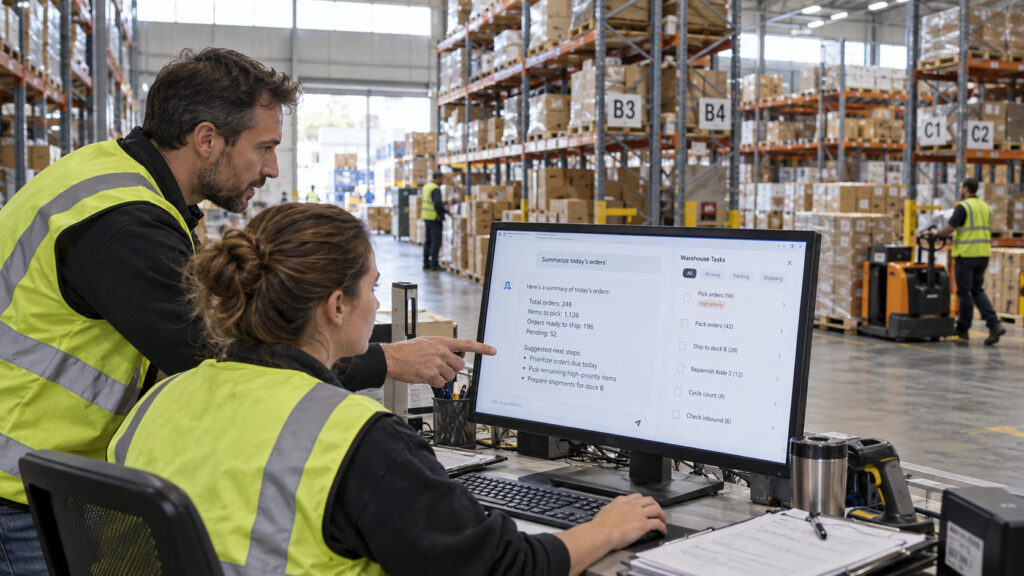
Generative AI in warehousing uses large language and multimodal models to create or revise operational content from approved business data. In warehouse logistics, that can mean drafting standard operating procedures, turning a master SOP into task-specific instructions, summarizing troubleshooting steps, or helping supervisors document exceptions faster.
This is different from agentic AI. GenAI primarily produces guidance and content for people to review and use. Gartner identifies operational-driven generative AI as one of four AI trends transforming warehousing and specifically points to dynamic SOPs, work instructions, exception-handling protocols, and decision support as practical applications.
Key Takeaways
- GenAI can speed up SOP drafting and updates, but approved procedures still need operational review.
- For 3PL warehousing services, AI work instructions are most useful when grounded in current WMS data, manuals, customer rules, and facility standards.
- Warehouse SOP automation can reduce documentation effort without removing supervisor accountability.
- Troubleshooting and exception guidance should show source context and escalation points.
- Security, data quality, integration, and human validation determine whether GenAI helps or creates new risk.
How Is GenAI Used in a Warehouse?

The strongest use cases are narrow, repeatable, and grounded in trusted information. A generative AI warehouse tool should not invent new operating rules. It should help teams retrieve, summarize, structure, and adapt existing knowledge for a specific task or situation.
|
Use Case |
Typical Inputs |
GenAI Output |
Required Validation |
|
SOP updates |
Approved SOP, WMS changes, process notes |
Draft revised procedure |
Process owner confirms sequence and controls |
|
Task instructions |
Master SOP, role, item or order context |
Short step-by-step instruction |
Supervisor verifies task accuracy |
|
Troubleshooting |
Manuals, known issues, error codes |
Guided diagnostic steps |
Technician or supervisor checks equipment guidance |
|
Exception protocols |
Customer rules, WMS status, escalation matrix |
Draft response and escalation path |
Operations lead confirms customer and facility rules |
|
Supervisor support |
Shift notes, KPIs, approved procedures |
Summary, checklist, or decision aid |
Supervisor reviews before action |
For example, if a WMS screen changes, GenAI can draft a revised receiving instruction using the new field names and an approved master SOP. A supervisor can then verify the sequence, safety notes, and system references before publishing it.
How to Implement GenAI for SOPs and Work Instructions
Start With Approved Source Material
Connect the GenAI tool only to current SOPs, equipment manuals, WMS documentation, customer requirements, and validated training materials. This helps warehouse logistics teams keep generated instructions grounded in approved operational information.
Define What the System Is Allowed to Produce
Set clear boundaries for whether the system can draft, summarize, translate, or suggest updates. Generated content should still go through the required review process before it becomes an approved procedure.
Build Human Review Into the Workflow
Assign an operations owner to verify process steps, equipment references, safety controls, and escalation rules before new or revised instructions reach warehouse associates.
Test With Real Warehouse Scenarios
Use common situations such as receiving errors, label exceptions, scanner problems, returns, and inventory discrepancies to test the workflow. Compare generated guidance with the warehouse’s approved response.
Control Versioning and Feedback
Track which source documents supported each instruction, who reviewed and approved changes, and when the content should be revalidated. This creates a clearer audit trail as SOPs and work instructions evolve.
Where Can Generative AI Fail in Warehouse Operations?
Inaccurate but Convincing Outputs
The main risk is output that appears reliable but is inaccurate or inappropriate for the situation. NIST’s Generative AI Profile identifies technical and model risks such as confabulation, data privacy concerns, value chain and component integration issues, harmful bias, and unsafe recommendations.
In a warehouse, these risks can affect inventory accuracy, equipment use, customer requirements, and worker decisions if generated instructions are not properly reviewed.
Poor or Outdated Source Data
Data quality is another constraint. If the AI retrieves an outdated SOP, incomplete customer rule, or incorrect reference document, the output may sound polished while still being wrong. Reliable source control is essential.
Weak System Integration
AI work instructions are less useful when they cannot reliably reference current WMS status, item attributes, or approved documents. Poor integration can create additional checking and verification work instead of reducing it.
Security and Data-Handling Risks
Sensitive customer data, pricing, employee information, facility layouts, and proprietary procedures should only pass through systems with appropriate access controls and data-handling policies.
Over-Reliance on AI Decisions
For 3PL warehousing services, GenAI should function as an operational support layer rather than the final authority. Supervisors and process owners should still review and approve the instructions used in day-to-day operations.
Frequently Asked Questions
How can warehouses measure whether GenAI documentation is useful?
Warehouse logistics teams can compare factors such as review time, correction frequency, document retrieval time, and how often employees need additional clarification. The most useful measures will depend on the workflow being tested.
Does a warehouse need to replace its WMS before using GenAI?
Not necessarily. Compatibility depends on how existing systems store and share operational information. Integration requirements should be reviewed before connecting GenAI tools to warehouse data.
Can GenAI help standardize documentation across multiple warehouse locations?
It can help apply consistent formats, terminology, and documentation structures across locations. Site-specific equipment, procedures, and operating conditions should still be reviewed separately.
What should warehouse teams consider when evaluating a GenAI vendor?
Consider how the system handles data access, storage, integrations, permissions, activity records, and review workflows. These factors can be especially relevant when GenAI interacts with operational information.
Can GenAI help with warehouse audit preparation?
GenAI may help organize approved records, summarize document histories, or locate relevant information. For 3PL warehousing services, the underlying controlled documents and records should remain the authoritative source.
Use GenAI to Support Better Warehouse Decisions
Generative AI can make warehouse logistics documentation faster to create and easier to adapt, but its value depends on accurate data, controlled processes, and consistent human oversight.
For businesses evaluating 3PL warehousing services, these same operational fundamentals remain essential for maintaining reliable workflows, clear procedures, and efficient warehouse operations.