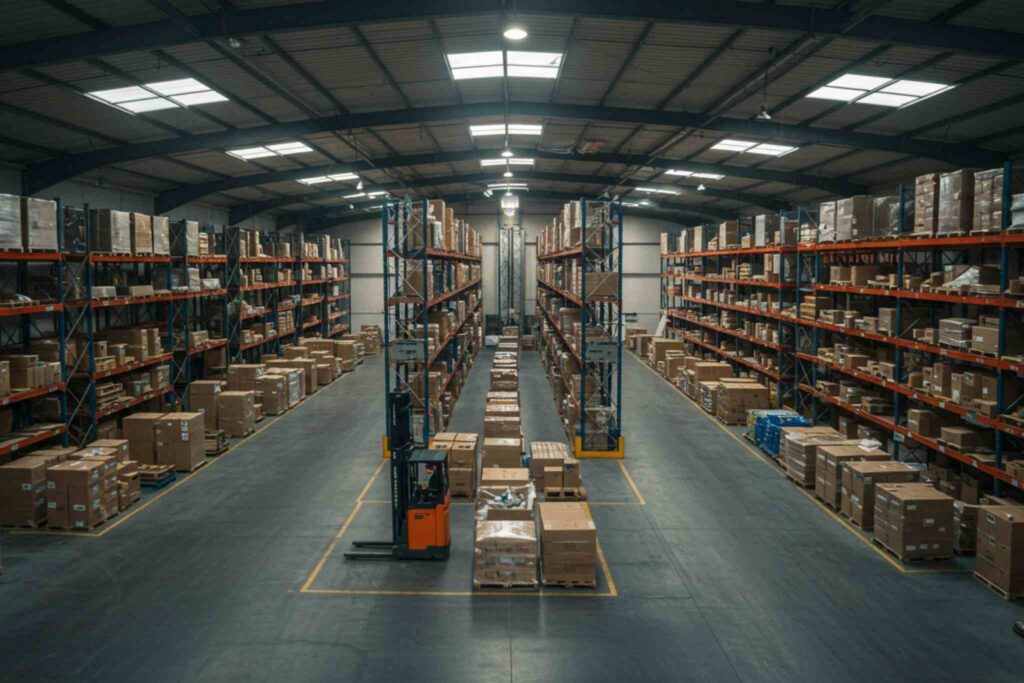

Commercial warehousing provides secure facilities for storing, managing, and distributing raw materials or finished products. That role matters more than ever as demand keeps shifting online. In the U.S., e-commerce accounted for 16.4% of total retail sales in Q3 2025.
If you sell into New York City, dense delivery zones and tight time windows make efficient operations and nearby inventory a must.
Table of Contents
Key Takeaways For Businesses Using Commercial Warehousing
Commercial warehousing includes receiving, inventory control, and fulfillment, not just storage.
Inventory accuracy depends on disciplined receiving, labeling, and cycle counting.
NYC fulfillment is less forgiving due to dense delivery zones and tight time windows.
A WMS-backed operation improves visibility, reduces errors, and supports scale.
Ask about processes, KPIs, and exception handling before you choose a provider.

What Commercial Warehousing Means For Businesses
The Bureau of Labor Statistics (BLS) tracks “Warehousing and Storage” as a distinct industry (NAICS 493), reflecting how specialized the work is. At its core, a commercial warehouse partner provides four things:
➤ Space: Racked storage, shelving, secure areas, and sometimes temperature control
➤ Labor: Trained teams to receive, move, pick, pack, and load product
➤ Process: Repeatable workflows that reduce errors and delays
➤ Systems: Inventory tracking and reporting, usually supported by a WMS
Inbound Receiving
Receiving is the first point where mistakes become expensive. A commercial warehousing company typically:
- Schedules inbound appointments
- Unloads containers or trucks
- Verifies counts against the bill of lading or ASN
- Inspects for visible damage and flags exceptions
- Labels and records items for inventory tracking
Clean receiving reduces downstream problems like mis-picks, backorders, and wasted labor searching for product that “should be here.”
Putaway and Storage
After receiving, inventory is put away into defined locations. This is how warehouses keep product findable and pickable.
Common storage setups include:
- Pallet racking for bulk inventory
- Shelving and bin systems for each-pick items
- Secure cages or controlled-access areas for higher-value goods
- Temperature-controlled storage when products require it
Good storage design is not about fitting the most products into the building. It is about making product flow predictable and reducing touches.
Inventory Management
If your inventory numbers are not reliable, everything else suffers: purchasing, customer service, and fulfillment speed.
Commercial warehouses typically use:
- Cycle counts (scheduled counting to catch variances early)
- Barcode scanning to reduce manual entry errors
- Lot, serial, or expiration tracking when required
- Quarantine workflows for damaged or suspect product
- Audit trails showing who moved what and when
This is where a Warehouse Management System (WMS) matters. A WMS helps track inventory by location and transaction, so you can see what is on hand and what is available to sell.
Order Fullfillment
For many businesses, this is the most valuable service. Warehouses convert inventory into outbound orders through:
Picking
Selecting the correct SKU and quantity, often using scanning and location controls. Pick methods may include:
Common storage setups include:
- Each picking (common for e-commerce)
- Case picking
- Pallet picking (common for wholesale and replenishment)
Packing
Packing is not just boxing. It includes:
- Choosing the right carton size
- Protecting the product with proper dunnage
- Applying brand inserts or packing rules
- Verifying order accuracy before sealing
Shipping
Shipping typically includes:
- Label creation and carrier handoff
- Manifests and shipment documentation
- Tracking number capture and status updates
Value-Added Services
Many commercial warehousing companies also provide value-added services (VAS) that keep work close to your inventory, including:
- Kitting and bundling
- Re-labeling or relabel compliance
- Light assembly
- Retail prep (ticketing, polybagging, labeling, carton requirements)
- Returns processing and restocking decisions
Freight and Transportation Coordination
Many warehouse providers coordinate inbound and outbound transportation, even if they do not operate trucks directly. Common coordination services include:
- Appointment scheduling for pickups and deliveries
- Carrier selection and documentation (BOLs, packing lists)
- LTL and FTL tendering
- Small-parcel label generation and tracking support
- Claims documentation for damaged shipments
What To Look For In A Commercial Warehouse Partner
Use this checklist to evaluate providers in New York, NY.
Operational Fit
- Do they handle your product type and storage requirements?
- Do they support your order profile (B2B, B2C, or both)?
- Can they scale labor during peak periods?
Receiving and Inventory Controls
- How do they handle inbound discrepancies and damages?
- Do they cycle count, and how do they resolve variances?
- Can they support lot, serial, or expiration tracking if needed?
Fulfillment Quality
- What accuracy controls exist during picking and packing?
- What are standard order cutoff times?
- How do they handle special packaging rules and inserts?
Visibility and Reporting
- What reports do you receive, and how often?
- Can they provide basic KPIs like order accuracy and turnaround time
- How do they share shipment tracking and confirmations?
NYC Execution
- Do they understand delivery windows and receiver requirements
- Are they positioned to support last-mile speed expectations?
- Can they coordinate pickups and appointments reliably?
Frequently Asked Questions (FAQs)
A warehouse primarily focuses on storing inventory safely and accurately. A distribution center is designed for faster throughput and more frequent outbound shipping, often with more labor and systems dedicated to picking, packing, and shipping daily.
Most pricing is a mix of storage fees (by pallet, bin, or square footage) plus handling fees for receiving, picking, packing, and value-added services. Some providers also charge for account management, returns processing, and special projects.
Onboarding time depends on SKU count, system integrations, labeling needs, and whether you are transferring inventory from another facility. Many businesses can be operational in weeks, but complex setups can take longer.
Typically: a SKU list, product dimensions/weights, monthly inbound and outbound volumes, order profiles (B2B vs. B2C), any special packaging rules, and compliance requirements like lot/expiration tracking.
A WMS is a warehouse management system that tracks inventory by location and movement. You do not need to own a WMS to outsource; most providers run their own. What you do need is visibility into inventory and shipments through reports or system access.
Strengthen Your Supply Chain With the Right Warehouse Partner
For New York, NY, businesses, commercial warehousing is the backbone that keeps inventory accurate and orders moving on time in a demanding delivery environment.
If you are evaluating commercial warehousing support in NYC, Warehouse Logistics By Best can help you build a more efficient logistics operation with secure storage, reliable fulfillment, and practical inventory management tailored to business needs.
To learn more or discuss your warehousing requirements, contact Warehouse Logistics By Best today.