
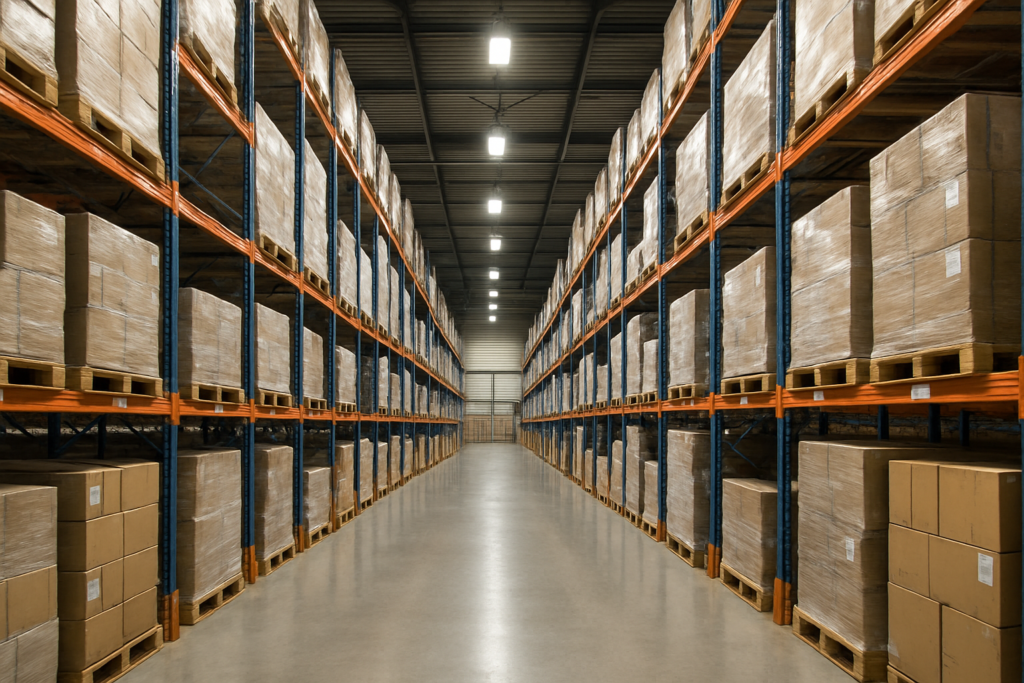
A warehouse is a facility primarily used to store goods for an extended period. A distribution center is designed to move products quickly to their final destination. Understanding the warehouse vs distribution center differences helps businesses make smarter decisions about where and how they store and ship inventory.
Table of Contents
- What a Warehouse Actually Does
- What a Distribution Center Actually Does
- Side-by-Side Comparison of Warehouse vs Distribution Center Differences
- Which Facility Does Your Business Need?
- Things to Know About Warehouse vs Distribution Center Differences
Key Takeaways
- Warehouses prioritize storage density; distribution centers prioritize throughput speed, according to PackageX, 2024.
- Distribution centers typically offer value-added services like kitting, fulfillment, and returns processing that warehouses do not.
- The U.S. warehousing market reached an estimated $221.4 billion in 2024, reflecting how central both facility types are to American commerce (Armstrong & Associates, 2026).
- E-commerce growth is pushing more businesses toward distribution center models: U.S. retail e-commerce sales reached $326.7 billion in Q1 2026, accounting for 16.9% of total retail sales (Speed Commerce, 2026).
- Many modern 3PL providers offer hybrid solutions that combine storage with active fulfillment.
- Choosing the wrong facility type can result in avoidable shipping delays, higher costs, and poor customer experience.
What a Warehouse Actually Does
A warehouse holds inventory. Its core purpose is to provide secure, organized storage for goods until they are needed. The need may arise in a week, or six months out. Businesses that buy in bulk, manage seasonal stock, or need overflow capacity are the primary users.
Inside a traditional warehouse, operations are straightforward. Receive goods, store them systematically, and release them when orders arrive. Technology plays a supporting role here. The main metric is how efficiently floor space is used. Understanding how to calculate the warehouse space your business actually needs is one of the first steps any business should take before committing to a storage arrangement.
Moreover, warehouses serve industries like manufacturing, wholesale, and retail. These sectors manage inventory cycles that are slower and predictable. They are not optimized for rapid order turnaround, and that is intentional.

What a Distribution Center Actually Does
A distribution center (DC) is built around movement, not storage. Goods arrive and get sorted, processed, and shipped out quickly. Sometimes this happens within hours. The facility is designed to minimize dwell time for inventory and maximize order velocity.
Distribution centers handle a much broader range of operations than warehouses. These include pick and pack, kitting and assembly, labeling, returns processing, and last-mile delivery coordination. Furthermore, value-added warehousing and distribution generates significant revenue. This category covers fulfillment, kitting, and returns, generating $69.6 billion in gross revenue and accounting for 61.3% of U.S. commercial warehousing revenue, according to Armstrong & Associates (2026).
The technology investment is also higher. Real-time warehouse management systems (WMS), barcode scanning, and automation are standard. Additionally, the warehouse automation market is anticipated to grow from $21.42 billion to $24.09 billion by 2025. This represents a yearly growth rate of 12.4%, according to Omniful, 2025. That growth is driven almost entirely by demand for faster fulfillment.
For businesses operating in e-commerce, understanding real time inventory tracking how businesses stay in control of their stock is critical. Distribution centers rely on live data to keep order accuracy high and shipping windows tight.
Side-by-Side Comparison of Warehouse vs Distribution Center Differences
| Feature | Warehouse | Distribution Center |
|---|---|---|
| Primary function | Long-term storage | High-speed order fulfillment |
| Inventory turnover | Slow to moderate | Fast |
| Services offered | Storage, basic receiving | Pick/pack, kitting, returns, shipping |
| Technology intensity | Moderate | High |
| Best for | Bulk buyers, seasonal stock | E-commerce, retail replenishment |
| Cost driver | Storage volume | Throughput and labor |
Average peak warehouse space utilization fell from 78.5% in 2023 to 73.2% in 2024, according to Modern Materials Handling/Logistics Management (2024). That dip signals shifting demand patterns. More businesses are prioritizing DC-style operations over pure storage.
Which Facility Does Your Business Need?
The right choice depends on your inventory behavior and your customer expectations. If you hold large volumes of product for extended periods and ship infrequently, a warehouse likely serves you better. In contrast, if you process dozens or hundreds of orders daily, a distribution center is the appropriate model.
Many businesses need both. In addition, that is where 3PL providers like Warehouse Logistics NYC prove useful. We offer short-term and long-term storage alongside active fulfillment services, B2B and B2C order processing, and freight coordination. Businesses operating in dense markets can also benefit from the logistical advantages covered in our post on 6 benefits of warehouse storage in new york city.
Regardless of which model you choose, maintaining stock accuracy is non-negotiable. Moreover, reviewing why regular inventory audits are essential for commercial storage gives businesses a clear framework. This framework helps you stay on top of what you hold and where.
Things to Know About Warehouse vs Distribution Center Differences
- Distribution centers are not just larger warehouses. They require different staffing models, technology stacks, and operational workflows.
- Not every 3PL handles both functions equally. Verify whether a provider is optimized for storage, fulfillment, or both before signing a contract.
- E-commerce brands often outgrow pure storage arrangements faster than expected as order volume scales.
- Capital expenditure budgets for warehouse and DC operations increased from $1.15 million to $1.8 million in 2024. This reflects growing investment in facility upgrades and technology (Logistics Management, 2024).
Talk to a 3PL That Handles Both Storage and Fulfillment
If you are still weighing your options, working with a provider that operates across both models removes the guesswork. At Warehouse Logistics NYC, we tailor storage and fulfillment solutions to your actual order volume and inventory profile. Request a free estimate today and tell us exactly what you need — we will build a solution around it.
Frequently Asked Questions
Q: Can a warehouse become a distribution center?
Yes, warehouses can be converted or upgraded into distribution centers, but it requires significant operational and technology changes.
The transition involves adding fulfillment systems, WMS software, and labor processes. These processes handle picking, packing, and shipping. However, not every warehouse facility has the layout or infrastructure to support high-throughput operations without structural modification.
Q: Are distribution centers more expensive than warehouses?
Distribution centers typically cost more to operate because they require more labor, technology, and faster processing speeds.
The trade-off is faster order turnaround. As a result, shipping times decrease and customer satisfaction improves. For e-commerce businesses, the operational cost increase often delivers better returns through increased sales velocity and reduced cart abandonment.
Q: What is the difference between a warehouse and a distribution center in terms of inventory dwell time?
Warehouse dwell time typically ranges from weeks to months, while distribution center dwell time is measured in hours to days.
In a warehouse, goods may remain in storage until scheduled orders pull them out. In contrast, a distribution center receives inventory and processes outbound shipments almost immediately. This difference fundamentally shapes facility design, staffing needs, and technology requirements.